
Building a Hamam in Bali or Jakarta: What Hotels and Villa Owners Should Know
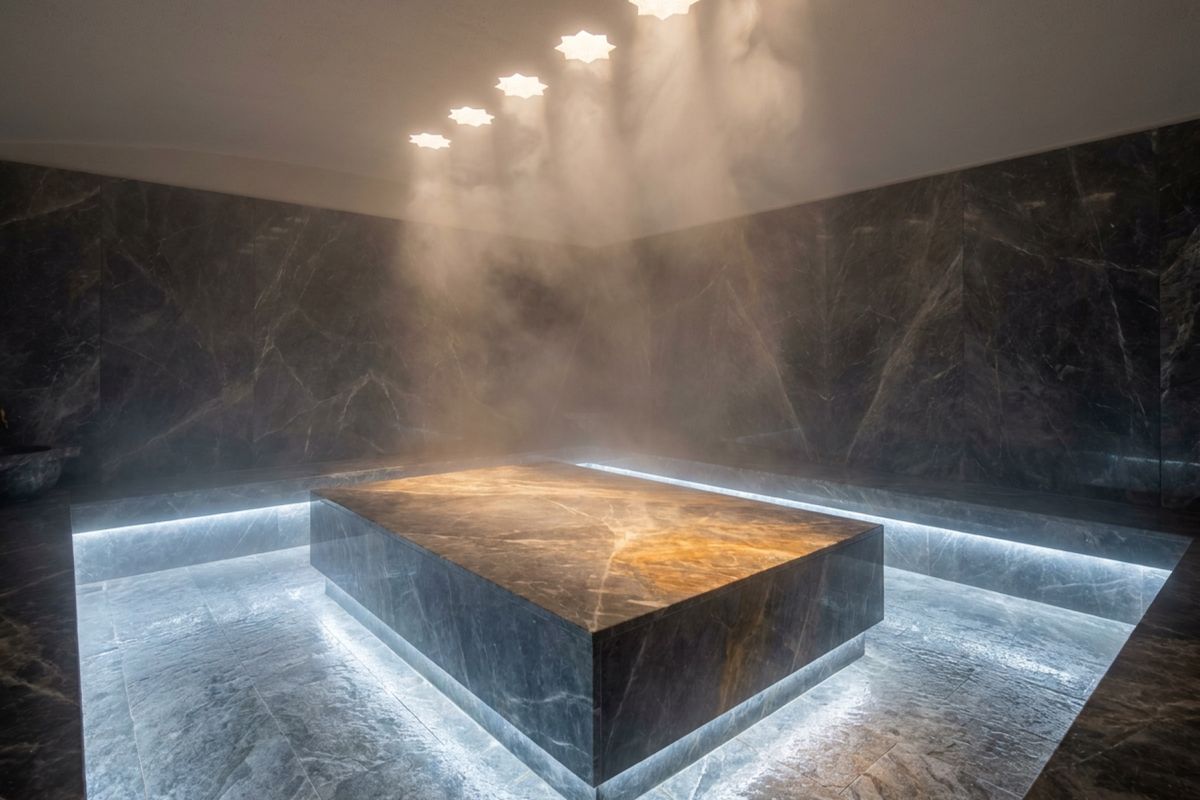
Guests who have been to Istanbul or a good European spa know what a hamam is, and they notice when a hotel has one. In Bali and Jakarta it is still rare. Most properties offer a sauna, sometimes a steam room, and stop there. That gap is the commercial case for a hamam: it is a ritual people book and pay for, and few competitors offer it.
It is also the most construction-heavy room in a wellness zone. Here is what an owner should understand before asking for a design.
Hamam or steam room: what is the difference?
Both rooms are warm and humid, and both get called "steam". The difference is how heat reaches the guest and what happens inside.
- Steam room. A compact sealed room, usually 40–48°C at close to 100% humidity, heated by a steam generator. Guests sit for 10–15 minutes and leave. No staff needed.
- Hamam. A larger stone room at a gentler 40–50°C. Heat comes from warm surfaces as well as steam: a heated marble platform in the centre (the göbek taşı), heated benches, and basins (kurna) with warm and cool water. The core of the experience is a treatment on the platform: a scrub with a kese mitt and a foam wash, done by a trained attendant.
So a hamam is partly a room and partly a service. If a property cannot staff the ritual, a well-built steam room may be the better investment. If it can, the hamam becomes a treatment with a price per session rather than a free amenity.
What goes into the room
Guests see the finishes. The work behind them decides whether the room still looks good after two years of daily steam.
- Waterproofing first. Walls, floor and ceiling are sealed with a continuous membrane before any stone goes on. A leak behind marble is found late and fixed expensively.
- A shaped ceiling. A dome or sloped vault lets condensation run down the walls instead of dripping on guests. A flat ceiling in a hamam shows its problem in the first week.
- Heated surfaces. The central platform and benches are warmed from below with hydronic or electric underfloor heating. This is what makes a hamam feel different from a steam room.
- Stone that suits the job. Marble is traditional, and backlit onyx is a popular accent. Both need proper sealing, and floors need a slip-resistant finish. Large-format porcelain is a practical choice for walls.
- Drainage. Floors fall to linear drains so water from the basins and treatments never pools.
- Sealed, low-voltage lighting. Fixtures rated for hot wet rooms, with their drivers mounted outside.
Sizing the steam
Stone absorbs heat. A steam generator that suits an acrylic or glass steam cabin will struggle in a marble room of the same volume, because the walls keep drawing heat out of the air. Generators for stone rooms are sized up for that reason, and the heated surfaces carry part of the load. This is worked out during design, not picked from a catalogue.
Building for the tropics
In Bali and Jakarta the outside air is already warm and humid. That affects the rooms next to the hamam more than the hamam itself: steam that escapes into a changing room or corridor turns into mould on ceilings and swollen door frames. The fixes are simple when planned early. Fit a door that closes properly, run extraction between sessions, and give the rest area mechanical ventilation or air conditioning to bring humidity down.
Water quality matters too. Hard or iron-rich water marks marble and scales up steam generators, so a softening or filtration stage on the supply is money well spent.
Where a hamam fits in a wellness zone
Guests usually move from gentle heat to strong heat, then to cold. A common route is hamam, sauna, ice bath or cold shower, then rest. A hamam is also a good warm-up before a massage, so it usually sits next to the treatment rooms rather than out by the pool. Our wellness zone construction page shows how the pieces fit together.
A private villa rarely needs a full hamam. A smaller steam room with a heated bench and one basin gives much of the feeling in a fraction of the space.
How a project starts
We need photos or a floor plan of the space, the ceiling height and an idea of how many guests should use it at once. From that we prepare a concept, a 3D render and a costed estimate. Design, stonework, heating and installation are handled by one team, so nobody has to coordinate a tiler, a steam supplier and a plumber who have never worked together.
FAQ
How big does a hamam need to be?
For a hotel hamam with a central platform for four to six guests, plan on roughly 15–25 m² plus a rest area. A compact villa steam room can fit into 4–6 m².
Does a hamam need staff?
The room works without staff, but the traditional scrub and foam treatment needs a trained attendant. Most hotels sell it as a spa treatment.
Can a hamam be added to an existing building?
Often, yes. The main checks are floor loading for the stone, a route for drains, a place for the steam generator and ventilation. We assess this from photos and plans before anything is designed.